Successful Laboratory Energy Optimization Programs Start with Buy-In

Key Highlights
- Vital to securing stakeholder support, especially from EHS and lab occupants, is demonstrating that safety and research integrity will not be compromised for energy savings.
- Implementing a control banding process provides a data-backed methodology to qualify lab spaces for energy conservation measures and to reassure stakeholders that safety is prioritized.
- Securing stakeholder alignment isn’t a one-time event; it requires active communication from initial assessment and implementation through measurement and verification.
Laboratories are high-intensity energy users, making them one of the best places to achieve significant inroads in carbon-reduction initiatives and energy-cost savings. However, executing a successful laboratory energy-savings program is challenging, largely due to the complexity of the environment and the sensitive operations performed combined with the need to prioritize and ensure safety.
Among the numerous hurdles is correctly qualifying laboratory spaces for energy conservation measures (ECM) such as occupied ventilation setback, unoccupied ventilation setback, and total exhaust reduction to fume hoods. Determining if a lab space is a good energy-conservation candidate based on energy usage can be complex as it may have needs that disqualify it from consideration. The control banding process provides the solution by systematically evaluating safety and operational factors to accurately qualify each space.
A frequently overlooked requirement is the need to secure buy-in from all stakeholders at the start. Without buy-in, missing stakeholder needs can delay the project or unintentionally undo any energy savings achieved. An energy savings program should start with careful communication with stakeholders to identify, prioritize and address their needs.
The Four Key Stakeholder Groups
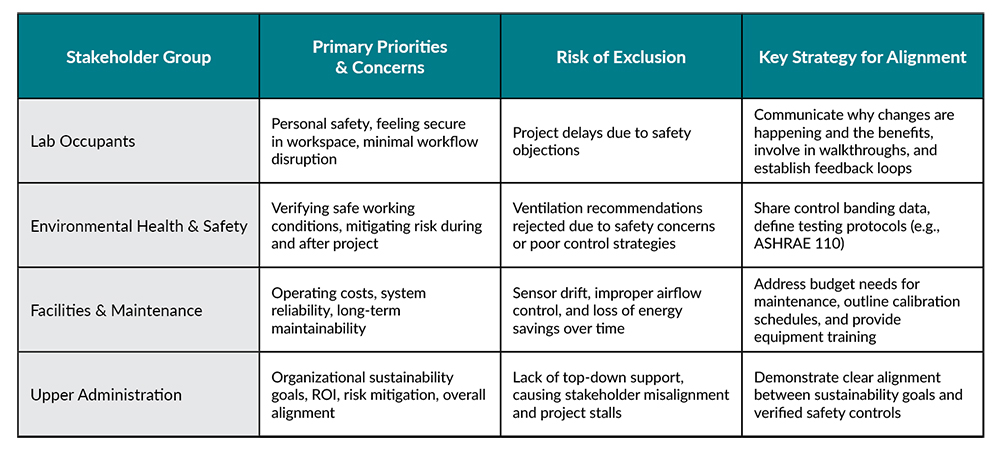
There are four main stakeholders and they each will have their own set of needs to consider. The four groups are:
- Laboratory occupants
- Environmental health and safety (EHS)
- Facilities and maintenance (FM)
- Upper administration
Most programs make the mistake of overlooking facilities and maintenance staff and laboratory occupants, yet these groups are essential to supporting ongoing energy savings. The laboratory occupants are the end users, making them a vital stakeholder in the process. Being safe and feeling safe while working in their environment is paramount. Without their buy-in, the project can be delayed or derailed by the lab occupants objecting to the project on the basis of their safety being compromised.
Communication is essential to obtain buy-in from lab occupants. All stakeholders must be aware of why the project is occurring, the benefits, how it will affect them, and how safety will be maintained. Feedback must be encouraged and addressed. Safety must be prioritized, and the control banding process is a tool to help ensure any optimization of laboratory ventilation is done safely.
The next stakeholder to consider is the institution’s EHS group. The primary priority for EHS is to maintain and verify safe work environments both during the project and after the project is complete. To obtain buy-in, their priorities can be addressed by a thorough review and execution of the control banding process, ensuring standard operating procedures (SOP) are in place for the laboratory spaces, and the development of policies and training methods for how safety is maintained and verified.
Methods to verify safe working environments may include ongoing trending of mechanical equipment performance, visible and audible alarms, regular fume hood face velocity testing, and ASHRAE 110 fume hood testing. Without buy-in from EHS, lab ventilation modifications can be rejected, causing the project to be delayed or disrupted.
Another important stakeholder is an institution’s facilities and maintenance (FM) group. Facilities managers are likely to be a key ally in the goal of reducing energy usage. Facility managers often will be expected to maintain any new building systems implemented as part of the project so it is important to communicate how the project will impact the building and how any new systems must be maintained. This may include the need for adjustments to maintenance budgets or the need for maintenance service contracts. Without proper maintenance such as regular inspection and calibration of sensors, mechanical systems can improperly control airflows within labs and the information they provide that is used to verify safe working conditions can be inaccurate.
The final stakeholder group is upper administration. Administration tends to drive energy reduction efforts, because much of this work begins in support of broader organizational sustainability goals. With their support, and a clear understanding of how this work fits into big-picture objectives, and still maintains the appropriate level of safety, most other stakeholders tend to fall into alignment. Consistent communication between stakeholders is key to the success of laboratory energy-reduction programs. If all stakeholder needs are not met, valid ECMs can be blocked or undone leading to the program yielding disappointing results by not achieving the expected savings, or worse, unintentionally causing safety concerns.
Ideally a representative from each main stakeholder group is part of the Project Team, which also includes representatives from internal and external resources such as experts and contractors all working towards successfully executing the project. Active participation from the four main stakeholder groups in the project team should be highly encouraged and any experts and contractors should be experienced in laboratory environments.
The Control Banding Process Builds Stakeholder Trust
Identifying laboratories for energy optimization measures can easily trigger anxiety among researchers and EHS teams if they feel decisions are based solely on energy targets. This is where the control banding process becomes essential for securing buy-in.
Control banding is a systematic risk-assessment that categorizes laboratories based on hazard levels, chemical usage, and operational risks. By mapping spaces into clear risk tiers (typically levels 1 through 4), the process identifies which labs are good candidates for ventilation setbacks and which require safety enhancements before any energy conservation measures can be introduced. Control banding provides a transparent process that reassures all stakeholders that safety is being prioritized.
The control banding process is covered in greater detail in our blog post: Laboratory Energy Optimization: Safe, Risk-Based Strategies for Campus Sustainability
Engaging Stakeholders Across the Three Project Phases
Maintaining stakeholder buy-in isn’t a one-time event, it requires ongoing communication and collaboration across all three project phases.
Phase 1: Study and Analysis
Phase 1 is where the project team lays the foundation for the whole project. In this phase, stakeholders are identified and interviewed, site walkthroughs are performed, and existing equipment is inspected to observe conditions. These steps allow the project team to identify required corrective measures to existing systems, determine which ECMs are viable, and develop execution plans for how to implement the potential ECMs. Findings and execution plans are then presented to the stakeholders for feedback. Once all feedback is reviewed, the project’s scope of work and execution plans are finalized. It is critical to make sure every stakeholder understands what is happening in the project, how the work is being executed, and how their feedback will be accounted for.
Phase 2: Implementation
The implementation phase starts with a meeting to re-introduce the project to all the stakeholders and make sure they are aware of and understand the work to be undertaken. This is followed by site walkthroughs with stakeholders to point out equipment modifications and to review project schedules. Once the work is underway, it is important to evaluate the effectiveness of the execution plan and make adjustments, as needed to minimize disruption to the laboratory users.
Phase 3: Measurement and Verification
In this phase, a commissioning process should be performed to verify that the work executed matches the work planned and that any deficiencies are identified, documented, and corrected. This step is important for all projects but is doubly important for laboratory energy-reduction projects due to their importance for maintaining ventilation and safety. It is important to make sure the building systems (HVAC systems, control systems, and laboratory equipment, etc.) are operating correctly when the work is complete, and that the institution is knowledgeable and prepared to provide the required maintenance.
Once it is verified that the work has been implemented and is functioning properly, the effectiveness of the ECMs should be monitored over time. Thorough monitoring is recommended for at least one year after project completion to observe building performance throughout all seasons. This will increase the likelihood that any remaining adjustments are completed and that the savings achieved are maintained.
Balancing Safety, Stakeholder Alignment, and Energy Goals
Laboratory energy-reduction programs succeed by effectively communicating the project plan and prioritizing occupant safety. In securing stakeholder buy-in, your program will get off on the right track to help achieve energy saving goals. Employing the control banding process will help ensure identification of laboratories that best qualify for ECMs without compromising safety or research.
Ready to evaluate your laboratory spaces for safe energy reduction? Contact our team to learn how we can help guide your program.





Subscribe
to our blog
"*" indicates required fields