LEED v5 Pre-Occupancy IAQ Testing Credit: Key Changes, Testing Options, and Compliance Strategies
Key Highlights
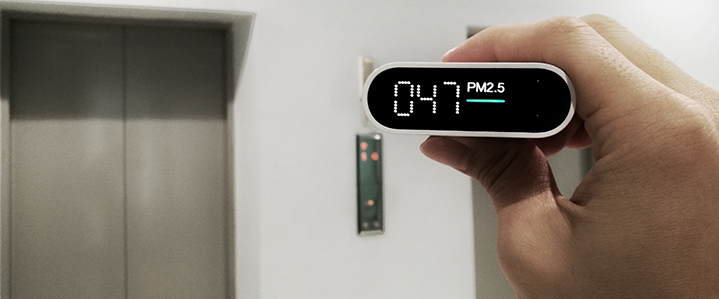
Flush-outs are out. Data-driven IAQ testing is in. LEED v5 eliminates the flush-out as a credit pathway and only allows performance-based, indoor air-quality testing that measures contaminants like particulate matter, inorganic gases, and VOCs, making IAQ a measurable indicator of building health.
More ways to earn points. Projects can earn up to two points through pre-occupancy IAQ testing, with an additional compliance pathway available for continuous indoor air-quality monitoring using permanent sensors during building operation.
Smarter, more efficient testing. Updated sampling location selection based on square footage reduces testing complexity and cost, while real-time data and targeted VOC analysis provide clear, defensible proof of indoor air quality performance before occupancy.

6 Minute Read

The construction process can introduce a wide range of contaminants into the indoor environment — from airborne dust to volatile organic compounds (VOCs) that, if not properly managed, can negatively affect occupant health, indoor air quality, and sustainable building performance.
Under the U.S. Green Building Council’s Leadership in Energy and Environmental Design (LEED) v5 for Building Design and Construction (BD+C) and Interior Design and Construction (ID&C), teams pursuing the indoor air quality (IAQ) assessment credit must now meet performance-based verification requirements. This approach reframes air quality as an ongoing operational metric, directly tied to long-term building performance, decarbonization, and occupant health outcomes.
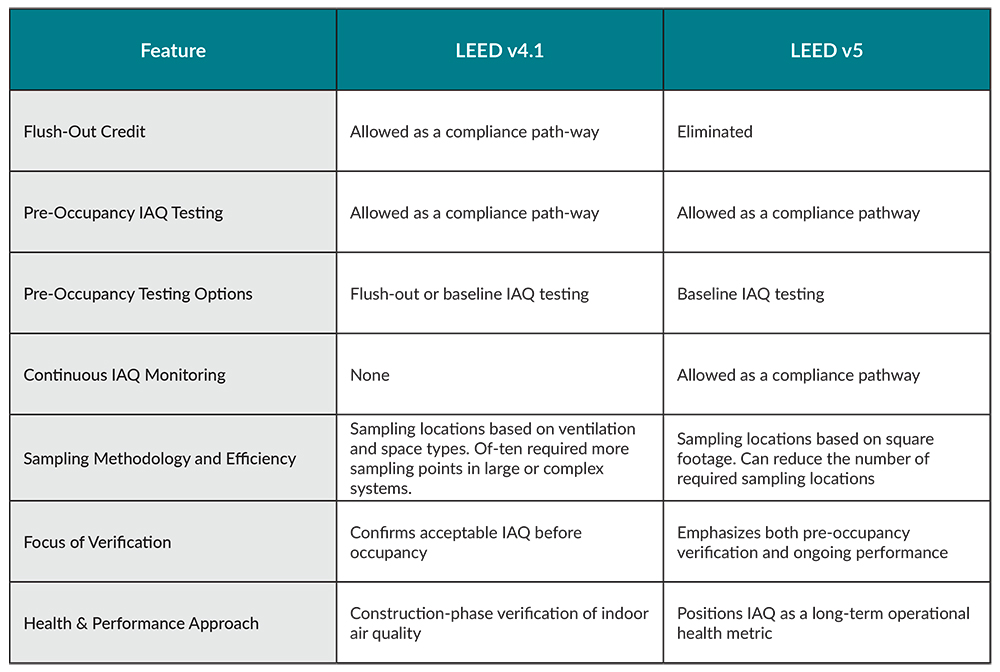
While LEED v4.1 focused on demonstrating acceptable IAQ prior to occupancy through building flush-out or baseline IAQ testing, LEED v5 elevates the standard by placing stronger emphasis on IAQ testing and eliminating the flush-out option. This shift aligns IAQ verification more closely with building health goals, integrating air quality into broader performance-based strategies.
LEED v5 Indoor Air Quality (IAQ) Credit: What Has Changed?
LEED v5 IAQ testing is a pre-occupancy verification process that measures contaminants such as particulate matter, inorganic gases, and VOCs to ensure buildings meet indoor environmental quality standards required for LEED certification. Within the LEED v5 Indoor Environmental Quality (EQ) Assessment Credit, Air Quality Testing and Monitoring, the option to earn this credit via building flush-out before and after occupancy has been eliminated. Construction teams now have the option to earn credits via the following testing options:
Option 1 – Pre-Occupancy Air Quality Testing
Pre-occupancy IAQ testing under LEED v5 provides a measurable way to verify indoor air quality before building occupancy. This category under the LEED v5 requirements contains two testing paths that each earn one point, and they are both performed after construction and before occupancy.
Path 1: Particulates and Inorganic Gases
This pathway measures contaminants commonly associated with construction dust and combustion gases for LEED indoor air quality compliance:
- Particulate matter (PM2.5 / PM10)
- Carbon monoxide
- Ozone
Path 2: Volatile Organic Compounds (VOCs)
Measures chemicals emitted from materials and finishes, including:
- Total volatile organic compounds (TVOCs).
- Formaldehyde
- Benzene
- Other LEED-listed VOCs
Option 2 – Additional Compliance Path: Continuous Indoor Air Quality Monitoring
This is an alternative compliance pathway within the LEED v5 Air Quality Testing and Monitoring credit, allowing projects to earn one point by installing permanent indoor air-quality sensors that continuously track key IAQ parameters during building operation. These sensors typically are integrated into building automation or smart-building systems and also can contribute to LEED points under Building Operations and Maintenance Programs. Parameters that must be monitored include:
- PM2.5
- Carbon dioxide (CO2)
- TVOCs
- Temperature
- Relative humidity
While this option offers the opportunity to earn a credit for ongoing verification of IAQ in buildings, installing sensors may be cost-prohibitive for many construction projects. Also, there are ongoing costs associated with maintaining a continuous monitoring system.
Sampling Methodology Simplified
The number of pre-occupancy sample locations now is based on total square footage, which should result in less testing in many buildings. Under v.4.1, the requirement was based primarily on unique space types and ventilation system zones, which often resulted in more sampling locations and higher testing costs.
LEED v5 Pre-Occupancy IAQ Testing: Benefits and Compliance Strategy
One of the perceived drawbacks of IAQ testing traditionally has been the upfront cost. However, the two pre-occupancy air testing paths available under Option 1 of the LEED IAQ credit provide project owners with a straightforward and potentially cost-effective way to obtain objective data demonstrating indoor air-quality performance. For projects pursuing additional points toward a higher level of LEED certification, the cost associated with expanded testing can be well worth the investment.
Under Path 1, real-time, direct reading instruments are used to measure particulate matter and inorganic gases, including contaminants such as carbon monoxide and ozone. These tests are conducted using approved methods, with established allowable thresholds. Because the measurements are collected in real time, results are available immediately without the need for laboratory analysis. This allows project teams to quickly verify indoor air-quality conditions and address any potential concerns before occupancy. In many cases, Path 1 testing also can be completed more quickly and at a lower cost than more comprehensive laboratory-based testing.
Path 2 focuses on VOCs that may be emitted by building materials and finishes, including compounds such as formaldehyde, benzene, and vinyl acetate. Air samples collected for VOC analysis must be sent to an accredited laboratory for analysis, which can take days to process. If concentrations of specific VOCs exceed the thresholds established by LEED, the affected area must be investigated and any identified sources addressed before retesting occurs. Under more recent updates to the credit framework, TVOC concentrations are no longer treated as a strict pass-or-fail criterion. Instead, elevated TVOC levels trigger further investigation to identify potential sources, correct any issues, and conduct additional testing if necessary.
LEED Credit, Indoor Environments, and Construction Expertise is Critical
IAQ testing can be performed in a timely manner, provides hard data that can be used to attract tenants and assure occupants of a healthy environment and provides an opportunity to earn multiple points, so it is often an attractive option for securing the LEED IAQ credit. After all, a single point can often be the difference in which level of certification a project achieves.
Project teams must enlist a qualified expert to develop and conduct the testing. An experienced consultant will design a testing program that ensures that the correct methodology is used, that all the testing parameters are met, and that laboratories analyzing the samples are properly accredited for the methods used.
A strong understanding of built environments and the construction process is necessary to determine the number of samples needed and when and where they should be collected. Additionally, the testing company must be knowledgeable about regional air- quality conditions and EPA regulatory compliance to determine what additional measurements are required.
Using a qualified consultant can also significantly improve the chances of successfully achieving the LEED IAQ testing credit. Environmental consulting firms specializing in indoor air- quality testing, such as EH&E, frequently support project teams in designing compliant LEED IAQ testing programs.
If you need help successfully navigating the IAQ Credit for your LEED project, contact us today!





Subscribe
to our blog
"*" indicates required fields